You report three job changes in four years, recurring money pressure after each transition, and a current desire to relocate again because the present situation feels stagnant.
ILLUSTRATIVE REPORT PREVIEW
See what an AOIS™ report can tell you about a real-life problem.
These fictional illustrations show the client-facing form of a Standard dossier and Advanced strategic annex. They are not delivered client reports or evidence of measured outcomes. You can inspect the reasoning, evidence limits, and recommendation style here without seeing another client’s private information or the Institute’s protected internal calculations.

A plain-language answer you can use—not only an analysis you can admire.
The report identifies what is repeating, what pressure is acting on the system, where your position is stable or distorted, what capacity and resources are available, and which next moves the evidence supports. You should finish with a clearer understanding of what to do, what not to force, what to watch, and when the situation should be reassessed.
The first example below is personal so an individual visitor can see how the report applies to ordinary life. A separate business example follows in the Advanced section.
STANDARD REPORT FORMAT · FICTIONAL PERSONAL CASE
What a decision-ready excerpt looks like.
ILLUSTRATIVE CASE · NOT A CLIENT REPORT
Imagine a person who has changed jobs several times, feels financially stuck, and is considering another major move because life no longer feels like it is progressing. The circumstances and findings below are entirely invented to show the Standard report format. No real client or outcome is represented.
DECISION BRIEF
You may feel as though another move is the clearest way to get unstuck. The evidence in this example does not support making relocation the first answer yet. The stronger next step is to understand why earlier transitions became fragile, stabilize income, housing, and support, and then compare locations from a position that gives you more choice rather than more urgency.
The repeated pattern is not simply 'wrong jobs.' In this example, instability rises when you make a major change before income, housing, and support are secure enough to carry the transition.
You report that the strongest urge to make a major move usually appears after several months of frustration and a feeling that staying means failing.
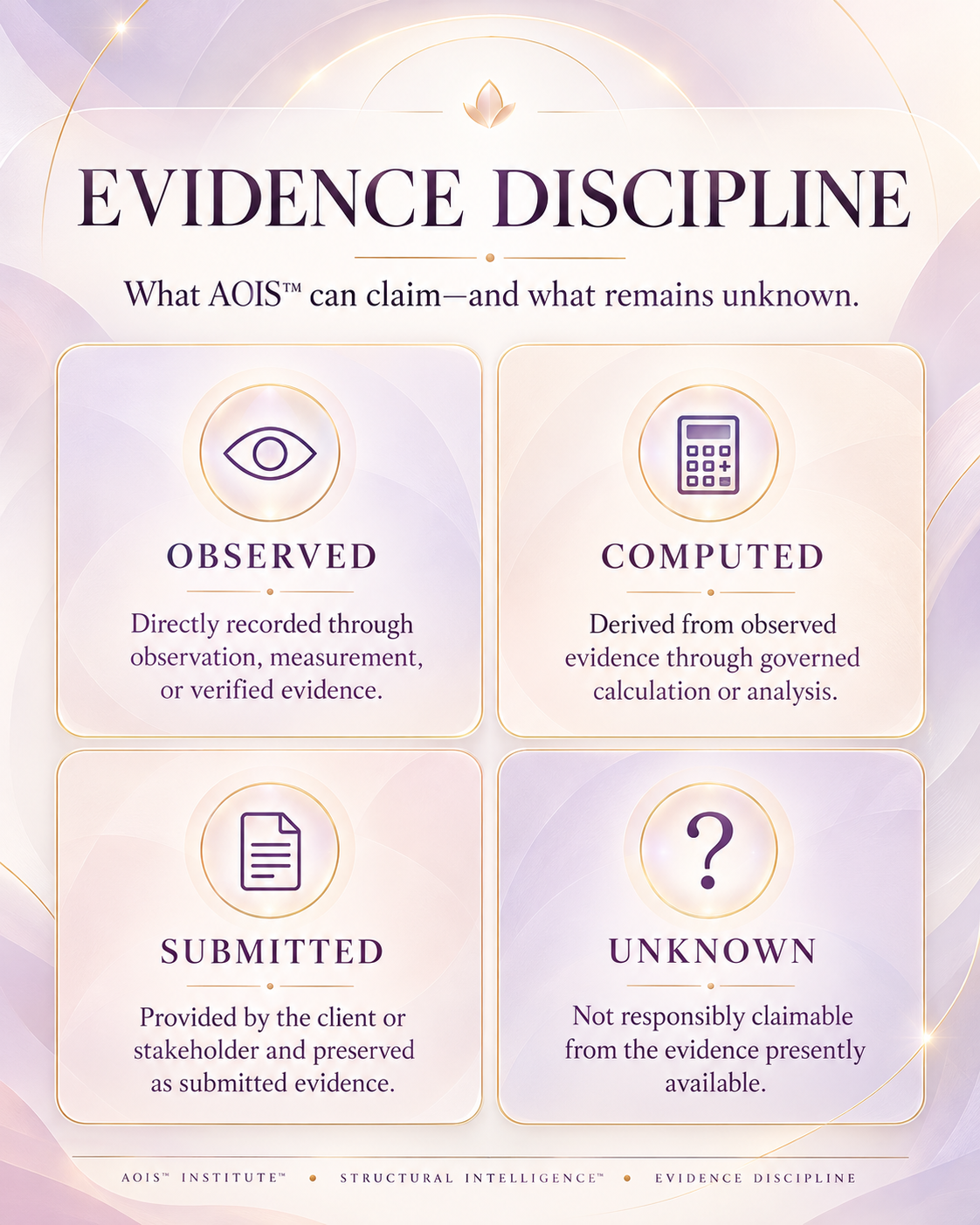
It is not yet known whether a new location would materially improve your income, support, or stability. Those claims need evidence rather than assumption.
GOVERNED RESPONSE
Do not make another major move only to escape the feeling of being stuck.
Separate the need for change from the assumption that relocation is the change required.
Strengthen income, housing, support, and transition capacity before committing to a move.
Review the decision after concrete location, cost, work, and support options are known.
What this illustration shows: The report format separates what the person reports, what the pattern suggests, what remains unknown, and what can responsibly be considered next. This invented case does not predict an outcome.
ADVANCED STRATEGIC ANNEX · FICTIONAL ILLUSTRATION
What the added decision comparison looks like.
ILLUSTRATIVE CASE · NOT A CLIENT REPORT
Imagine a consulting website that receives inquiries but few confirmed bookings. The following is a written illustration of the Advanced annex format, using invented circumstances. It is not an excerpt from a delivered report or evidence that AOIS has measured this website.
Is the offer unclear, or is the booking handoff failing?
Offer clarity: Visitors may understand the service but not which consultation fits. Check this against page language and interviews with prospective clients.
Booking friction: Interested visitors may decide to proceed but leave during scheduling. This remains a hypothesis until booking-step data or observed user tests are available.
Clarify the offer or repair the handoff.
Path A: Test one clearer service description with a small group. Requires an agreed primary offer; risks overlooking a technical booking fault. Stop if understanding improves but completed bookings do not.
Path B: Test the booking journey across devices and fix confirmed errors. Requires access to the scheduling flow; risks spending effort on a handoff that is already working. Stop if the flow completes reliably and qualified visitors still hesitate.
Learn what is failing before expanding.
Confirm the intended visitor and offer → inspect the full booking journey → test one change at a time → compare outcomes. Neither path supports an expensive site rebuild on the evidence currently described.
What if inquiries rise but bookings do not?
Higher inquiry volume would increase pressure without resolving the conversion question. Keep the changes reversible; reassess after the booking path has been observed and a defined sample of qualified inquiries has been followed through to an outcome.
Evidence boundary: No conversion rate, cause, or financial outcome is asserted for this invented case. An actual Advanced annex is generated from the purchaser’s case and includes the full Standard dossier, further explanation comparisons, decision conditions, scenario checks, and reassessment points. Protected cases may instead reach a human-review gate.
SEVEN CLIENT-FACING DIMENSIONS
AOIS uses seven functional dimensions: Identity & Direction, Life Conditions & Trajectory, Capacity to Act, Resources & Flow, Boundaries & Authority, Pressure & Friction, and Continuity & Sustainability. Each describes a defined condition in the situation being examined, rather than a fixed personal trait. Read every dimension alongside the other six and the available evidence.
Interpreted in relation to the specific case rather than treated as a fixed personality type.
Interpreted in relation to the specific case rather than treated as a fixed personality type.
Interpreted in relation to the specific case rather than treated as a fixed personality type.
Interpreted in relation to the specific case rather than treated as a fixed personality type.
Interpreted in relation to the specific case rather than treated as a fixed personality type.
Interpreted in relation to the specific case rather than treated as a fixed personality type.
Interpreted in relation to the specific case rather than treated as a fixed personality type.
What keeps repeating?
The report identifies the recurring architecture beneath the visible events and separates the core pattern from secondary symptoms.
What is acting on the system?
Pressure, friction, urgency, resource constraints, competing demands, and environmental forces are interpreted together.
What is actually ready to move?
The report distinguishes movement that is structurally supported from movement that should be clarified, held, reduced, released, or postponed.
What should happen next?
Recommendations are sequenced through bounded next moves, evidence limits, reassessment triggers, and protected human-review thresholds.
A FULL DOSSIER MAY INCLUDE
Executive assessmentPlain-language summaryPattern / Pressure / PositionSeven-dimension interpretationStructural strengths & risksDecision rationaleImplementation sequenceReassessment triggersPlace and timing context when the data supports itEvidence classificationEvidence limitsGoverned next moves
Transparent about the conclusion. Protective of private methodology.
These fictional examples show the client-facing reasoning format without exposing protected source mappings, internal calculations, restricted canon, or private client information. Here, “restricted canon” means private source material, internal mappings, and Founder-governed method records that are not part of the public client report. Private client reports remain private and access-controlled.
READY TO APPLY THE SYSTEM TO YOUR SITUATION?