Academic & philosophical foundation
Theology, traditional African religions, philosophy, epistemology, ethics, comparative religion, and the study of how human beings establish meaning, truth, responsibility, and order.
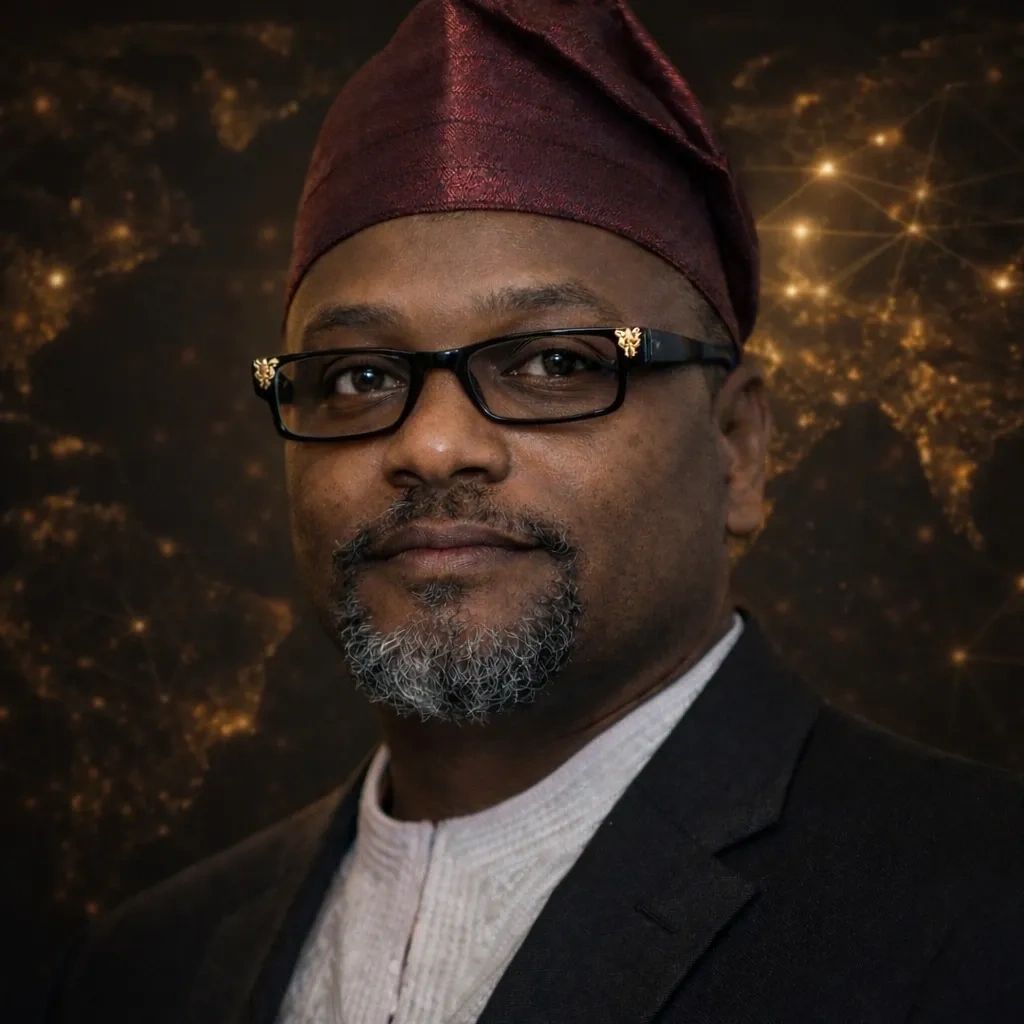
Founder and Global Architect of AOIS™ (Applied Operational Intelligence System™) and the AOIS™ Strategic Pattern Intelligence™ framework.
His academic and intellectual work spans theology and philosophy; traditional African religions; systems, complexity, and cybernetics; consciousness and behavioral studies; decision, risk, and strategic intelligence; governance and organizational dynamics; comparative cosmology; health and traditional medicine; economics and resource flow; information, computation, and artificial intelligence; environmental and geospatial inquiry; and applied diagnostic practice.
Across these fields, he has pursued one persistent question: how do pattern, timing, consciousness, environment, relationship, authority, and human choice combine to produce the life a person or institution actually experiences?
AOIS™ grew through years of study, writing, advisory work, and applied diagnostics. Over time, that work developed a precise language for pattern, pressure, position, timing, authority, and continuity. The website is a new way to deliver the work. It is not where the work began.
AOIS™ grew from decades of inquiry into how human lives and complex systems are shaped by pattern, timing, relationship, environment, consciousness, and choice. Ifá and consciousness-centered West African philosophy provided a major intellectual foundation, while systems theory, cybernetics, Jyotiṣa and Vedic studies, Buddhist philosophy, traditional healing sciences, consciousness research, comparative religion, and contemporary organizational and computational thinking widened the field of study.
Across these disciplines, the Founder encountered different languages for enduring human questions: Who am I? What is my purpose? Why do certain patterns repeat? When is the right time to act? What must change before an outcome can change? AOIS™ brings those questions into a distinct and coherent framework for examining structure, position, timing, and supported action.
This comparative journey informs AOIS™ without blending separate traditions or disclosing sacred methods. The result is an original secular system with its own language, standards, and diagnostic architecture.
AOIS™ examines human life and institutional behavior across multiple scales: consciousness, relationship, health, place, resources, authority, timing, information, and manifested outcome. Its formation therefore required sustained inquiry across fields that are usually studied separately.
These areas are not presented as interchangeable traditions or as separate professional licenses. Together, they describe the interdisciplinary study, comparative research, field experience, and applied practice that informed the Founder’s original synthesis.
Theology, traditional African religions, philosophy, epistemology, ethics, comparative religion, and the study of how human beings establish meaning, truth, responsibility, and order.
Systems theory, feedback, recursion, emergence, regulation, adaptation, homeostasis, resilience, interdependence, and continuity supplied a language for understanding why outcomes repeat and how systems change.
Consciousness studies, cognition, perception, identity, attention, motivation, behavioral patterning, psychological pressure, and symbolic meaning widened the inquiry into how people interpret and respond to experience.
Decision theory, scenario analysis, anticipatory intelligence, probability, uncertainty, risk, causation, evidence, timing, reversibility, and consequence support disciplined judgment when outcomes cannot be known in advance.
Organizational behavior, institutional dynamics, authority, hierarchy, leadership, communication, conflict, resource allocation, operational dependency, and governance show how collective systems hold or lose coherence.
Relational dynamics, family systems, reciprocity, attachment, role formation, developmental patterns, social networks, culture, and anthropology help explain how individual outcomes are shaped within larger human fields.
Ifá and consciousness-centered philosophy, Jyotiṣa, Vedic studies, Buddhist philosophy, comparative cosmology, symbolic sciences, and initiatory traditions provided distinct ways of studying cycles, timing, consciousness, causation, and purpose.
Naturopathy, traditional medicine, Chinese medical study, physiology, stress, recovery, environmental influence, longevity, and whole-person regulation contributed to understanding the human being as a living system.
Information theory, classification, pattern recognition, computational ontology, knowledge representation, modeling, artificial intelligence, and human-AI governance support the formal preservation and bounded application of the method.
Geography, territory, mobility, home, environmental systems, locality, access, infrastructure, and geospatial conditions clarify how place can support, constrain, or alter a person’s or institution’s available movement.
Capital, wealth, exchange, incentives, markets, labor, ownership, allocation, operational capacity, and continuity economics help reveal how resources move and what a system can realistically sustain.
Decades of consultation, observation, writing, teaching, case analysis, and more than thirty-six journeys through West Africa connect interdisciplinary study with lived lineage, institutional responsibility, and applied field experience. Formal prospective outcome evidence is addressed separately through the Institute’s research program.
Ethnomathematician Ron Eglash documented recursive and fractal patterns in African architecture, settlement designs, art, and indigenous knowledge practices in African Fractals: Modern Computing and Indigenous Design (Rutgers University Press, 1999). His research provides a comparative scholarly context for studying mathematical organization, recursion, and complexity within African intellectual traditions.
This work is cited as related scholarship. AOIS™ is the Founder’s independently developed synthesis; Eglash’s research is not presented as a validation of AOIS™ diagnostics or as an endorsement or affiliation.
Read about African Fractals at Rutgers University Press · Watch Ron Eglash’s TED talk
The Founder holds a PhD in Theology, with a concentration in Traditional African Religions, from UniLogos University and a 2024 Doctor of Naturopathy (ND) from Rashtriya Vishwa Vidyapeeth, Mumbai. FACMED in Brazil conferred the title of Associate Professor in recognition of his contribution to the institution.
He also earned an accredited undergraduate degree in Tui Na (traditional Chinese manual therapy) from the International Institute of Chinese Medicine in Albuquerque, New Mexico, on April 29, 2001. His training adds a foundation in traditional Chinese approaches to bodywork and whole-person care to his multidisciplinary academic background.
On September 11, 2024, Logos University International (UniLogos) appointed him International Vice Chancellor on a pro bono basis and also named him its Official Representative in the Republic of Benin, West Africa; both appointments were issued for 12-month terms. The representative appointment states that the University placed trust in his ability to promote academic ideals and strengthen institutional relationships in the region. These documented roles form part of his experience in institutional representation, academic leadership, and organizational development.
An honorary professorial distinction conferred by Logos University International (UniLogos) is recorded separately from earned degrees and appointed academic roles.
Academic credentials were issued under the Founder’s English-language legal name. Documentation connecting those records to the Founder is available to qualified institutional, investment, or diligence parties on request.
Credential scope: AOIS™ reports degrees, titles, and appointments according to the issuing documents and does not extend those records beyond their stated scope. Academic credentials are not presented as professional licensure, and AOIS™ makes no independent claim of governmental, professional, or accreditor recognition beyond what the issuing institutions and bodies themselves state. Supporting records are available for qualified diligence review.
AOIS™ presents this background as Founder provenance only. The Institute’s credibility rests on its authored method, published work, governed diagnostics, research standards, and operating evidence—not on titles alone.
Explore AOIS™ books, research & provenance · Independent Google Books record for Practical Foundations of Ifá

Practical Foundations of Ifá: A Handbook of Ifá View and Practice is an early published work in the Founder’s corpus. Its treatment of Ifá philosophy, epistemology, symbolic pattern systems, decision logic, moral reasoning, and practical interpretation forms part of the intellectual lineage from which later AOIS™ structural-intelligence work developed.
AOIS™ was not assembled to fit a market trend. The books, fieldwork, definitions, diagnostics, and research came first. Software and AI came later to help preserve the method, apply it consistently, and keep its authority boundaries clear.
Founder authority and continuity: The Founder remains the Global Architect and governing authority for the authored methodology, restricted interpretive decisions, and protected intellectual architecture. AOIS™ currently operates commercially under Oracle Ifá LLC while retaining its separate secular identity. Operating under that company does not create a separate AOIS legal entity, nor does client access, investor review, or technical administration automatically confer rights to the method or Founder-restricted decisions.
Books and long-form works establish the intellectual foundation and make the development of the framework traceable.
Real-world use across personal, relational, family, business, institutional, and strategic contexts tests how the framework behaves under pressure.
Definitions, variables, structural laws, and computational representations formalize the method beyond a single case or practitioner.
The current platform extends the method into structured diagnostics, bounded AI synthesis, longitudinal comparison, and human-review thresholds.
Answer private questions about what is happening. Receive a report that explains the pattern, the pressure, and the safest next step in ordinary language.